

5 Easy Ways to Build Literacy at Home
Updated: Oct 15, 2020
I am passionate about education. It is something that was instilled in me from very young. My mother was a teacher back in her native country, Cuba. During the hardest time in my life, when I was losing my mother, I formed a special bond with my 3rd/4th grade teacher that helped me through. I was also the go-to teacher’s helper, an aid, and in the future educator programs all throughout my school years. Education is at the core of who I am. When my daughter was born, I felt to was only natural to instill that in her as well. I did it without even realizing it, since it is second nature to me to find a way to turn everything into a learning experience.
I get so many messages daily about what I’ve done and what I am doing with Isabella to build early literacy. Today I want to share some easy ways to make a literacy-rich environment that will be conducive to learning and helping your little one make connections. My first year as a teacher I taught kindergarten. I was absolutely mortified at the lack of background knowledge and skills my students had that year. It was literally mind-blowing to see that most parents today have the “the teacher will teach them that when they get to school” approach. Which I will tell you, with my years of experience, this is the WRONG approach. Parents are their child’s first teacher. Children learn for years from their parents before even entering any type of schooling- preschool, VPK, pre-K. You don’t want to wait for the teacher to do it, that already puts them behind the curve.
So here are some tips that I’ve used either in my classroom and/or with my daughter to help begin literacy early on:
Talking
Let’s start off so simple that it seems silly. Talking! Yes, talking to your child. When my daughter was a tiny baby, I would speak to her all day long. I would talk her through whatever it was we were doing. “Isabella, it’s time to change your diaper. Ok let’s lay here… Ok stay still, almost done. Okay, mommy is done changing your diaper.” You might feel kind of silly talking to a baby that can’t even hold their head up yet, I know I did but there are studies that show that children begin learning in the womb. By speaking to them at every opportunity once they’re born it will help them begin to associate words, actions, and feelings. No harm can come from talking through your day with your baby- except others might think you’re crazy.
Technology
Contrary to popular belief, there are television programs and apps that can aid in the learning process. When we change our perspective on technology and begin to view it was a learning tool instead of a babysitter, it can be very helpful when used correctly. At an early age, I found that Isabella (like most other babies and small children) loved music. I used that to my advantage and looked for educational programs that had music and taught concepts such as the alphabet, numbers, color, etc. With tablets, phones, television- the educational options are endless.
(I will be writing a whole blog post about using television as a learning tool very soon, because I truly feel like it has been helpful. I feel that I’ve learned to use it in the right way and I want to share that with you guys. I’ll even be sharing my favorite educational programs and how and when I use the television. It’s a lot of information so I feel I can better explain it in a separate post. Be on the lookout for that! )
Print Rich Environment
A print rich environment is what you encounter when you enter any classroom. It’s when a child interacts with many different forms of print. Children are unconsciously interacting with the world around them every minute, so why not make their environment one that’s beneficial to learning? Children are curious by nature. When you put things in front of them they will explore and if old enough, ask questions. THIS is learning. When Isabella was 1 and a half I decided to make my home a print-rich environment. Even though she was unable to read, she began to recognize words by sight and making connections, that was the goal. In a classroom, everything is labelled to help children build vocabulary and word/object association. This is why I decided to label everyday household items. I felt that this was an easy way to bring literacy into my home.
Book Bins
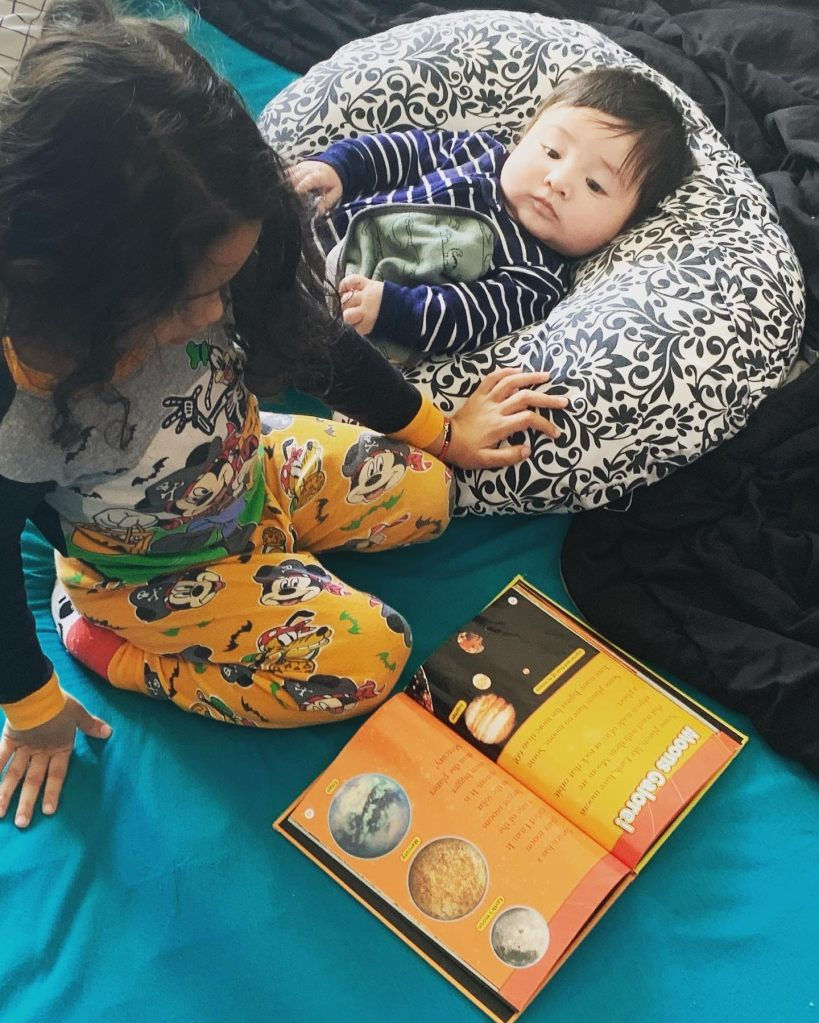
To continue with the theme of creating a print-rich environment, a super easy way to do this is using book bins. Ever since Isabella was in the womb I was reading to her- true story. When she was a small baby I bought soft books for her to hold and chew if she wanted to. By the time she was crawling, I began to set up book bins around my home. I do have books that I’ve put on shelves out of reach because of sentimental value. But others are placed in bins throughout my home. You want to make books accessible to children. Again, curiosity is your friend in the learning process- if it’s in sight, it’s in mind. Children will gravitate towards them. Another way I like to use book bins is seasonally or by holidays. I rotate books in and out so there’s always something new. If there’s a particular holiday or season coming up I make a themed bin. You will be surprised when you catch your little one exploring books on their own. Not all books have to be purchased, buying books gets expensive- trust me I know. Instead of cards for holidays or birthdays ask people to gift your child books with a special message written inside. Also, take advantage of your local library. The minimum checkout time is 30 days, you can always check out new and exciting books and keep your book bins fresh and free of cost!
1 on 1 Time
Spending uninterrupted one on one time with your little one is crucial not only for literacy development but for their development in general. You don’t have to spend an hour drilling flashcards or reciting sight words- just read to your child(ren). Make it a ritual to spend even 5 minutes daily reading to your children. Children of all ages can benefit from adult read alouds. I recently read a study that stated reading to your child is a “keystone habit”. A keystone habit is a habit that kicks off a chain reaction, influencing several other areas of life at the same time. Here’s something to think about for young children: Reading books exposes them to a wider variety of words. A child’s vocabulary upon entering school is an early predicator of their success since most instruction is oral for the first few years of school until they become fluent readers. Therefore, the child with the largest vocabulary will understand the most. And you can set them up for success with something as simple as reading to them- how amazing.
I hope that you’ve found some value and feel empowered by how easy it truly is to begin literacy at a young age. I know that it can be intimidating to try when you have no real background in teaching- I totally understand. But I’m here to tell you that you are not going to hurt your child or set them back by doing anything I mentioned. To give you a boost, I have included a free download of a household labels to get you started. The file is completely editable so you can change them as needed to fit your needs. I hope this will motivate you to begin to journey to literacy. I’m always here to help and give advice, just reach out.
Comments